If you need a PALS class in Citrus Heights, the most direct local option is Safety Training Seminars, an American Heart Association Training Center on Sunrise Boulevard. It offers the AHA Pediatric Advanced Life Support (PALS) Provider course through a blended format: you finish the online part first, then complete a short hands-on skills session in Citrus Heights. When you pass, you get your AHA PALS Provider eCard the same day, and it is valid for two years.
That covers the “where.” The rest of this guide is for the nurse, paramedic, or respiratory therapist who wants to know which PALS format fits their schedule, what the skills session involves, and what to confirm with an employer before booking.
What PALS Covers and Why Employers Ask for It
Pediatric Advanced Life Support is the American Heart Association’s advanced resuscitation course for clinicians who treat critically ill or injured infants and children. It builds on Basic Life Support (BLS) and focuses on spotting deterioration early, before a child reaches cardiac arrest.
The PALS curriculum typically covers:
- A systematic pediatric assessment approach (evaluate, identify, intervene)
- Recognizing and managing respiratory distress and respiratory failure
- Identifying and treating different types of shock
- Pediatric rhythm recognition, including bradycardia, tachycardia, and arrest rhythms
- Medication and dosing principles for children
- Airway management and ventilation
- Team roles and closed-loop communication during a resuscitation
Many hospitals, emergency departments, pediatric units, and EMS agencies require a current PALS card for credentialing. Requirements differ by employer and role, so check your facility’s policy on which PALS formats it accepts and how early you can renew.
Who in the Citrus Heights Area Typically Needs a PALS Certification Course
Citrus Heights sits in northeast Sacramento County, right next to Placer County. Many healthcare workers who live here work in either the Sacramento or Roseville hospital systems. Large facilities within a reasonable drive include Mercy San Juan Medical Center in neighboring Carmichael and the major hospital campuses in Roseville and Sacramento. Plenty of pediatric outpatient and urgent care clinics also operate along the Greenback Lane and Sunrise Boulevard corridors.
That mix means local demand for PALS comes from several groups:
- Emergency department and urgent care nurses who see pediatric patients regularly
- Paramedics and EMTs working for fire districts and ambulance providers in the region
- Respiratory therapists in pediatric, NICU-adjacent, or ICU settings
- Physicians, physician assistants, and nurse practitioners in pediatrics, family medicine, or emergency medicine
- Nursing and allied health students whose clinical placements or first jobs require PALS
If your role mainly involves newborns in the delivery room, your employer may require the Neonatal Resuscitation Program (NRP) instead of, or in addition to, PALS. Ask your unit educator which credential applies to you.
The Local Option: Safety Training Seminars on Sunrise Boulevard
Safety Training Seminars runs its Citrus Heights training center at 7625 Sunrise Blvd, Suite 209, Citrus Heights, CA 95610, close to the Sunrise Mall area and Greenback Lane. The center lists hours of 8 a.m. to 10 p.m., seven days a week. Evening and weekend skills appointments help clinicians on 12-hour shifts, who often struggle to fit a weekday class around their rotation.
The location offers the full set of AHA provider courses, BLS, ACLS, and PALS. It also offers NRP through the American Academy of Pediatrics, plus CPR and first aid classes. You can see the complete course list and other location details on the Safety Training Seminars Citrus Heights training center homepage.
The center is near the Placer County line, so it is a practical stop for providers coming from Roseville, Antelope, Orangevale, Fair Oaks, and Carmichael. Commute times vary with traffic, so check your own route before choosing an appointment slot.
How the PALS Course Format Works in Citrus Heights
The PALS option offered in Citrus Heights uses the AHA’s Self-Guided Learning model. It has two parts.
Part 1: Online cognitive training
The online part is HeartCode Complete PALS, an adaptive course that adjusts to what you already know. Safety Training Seminars estimates it takes about two to three hours. Experienced pediatric clinicians may move faster, and first-time learners may take longer. You complete it on your own schedule.
Part 2: Hands-on skills session
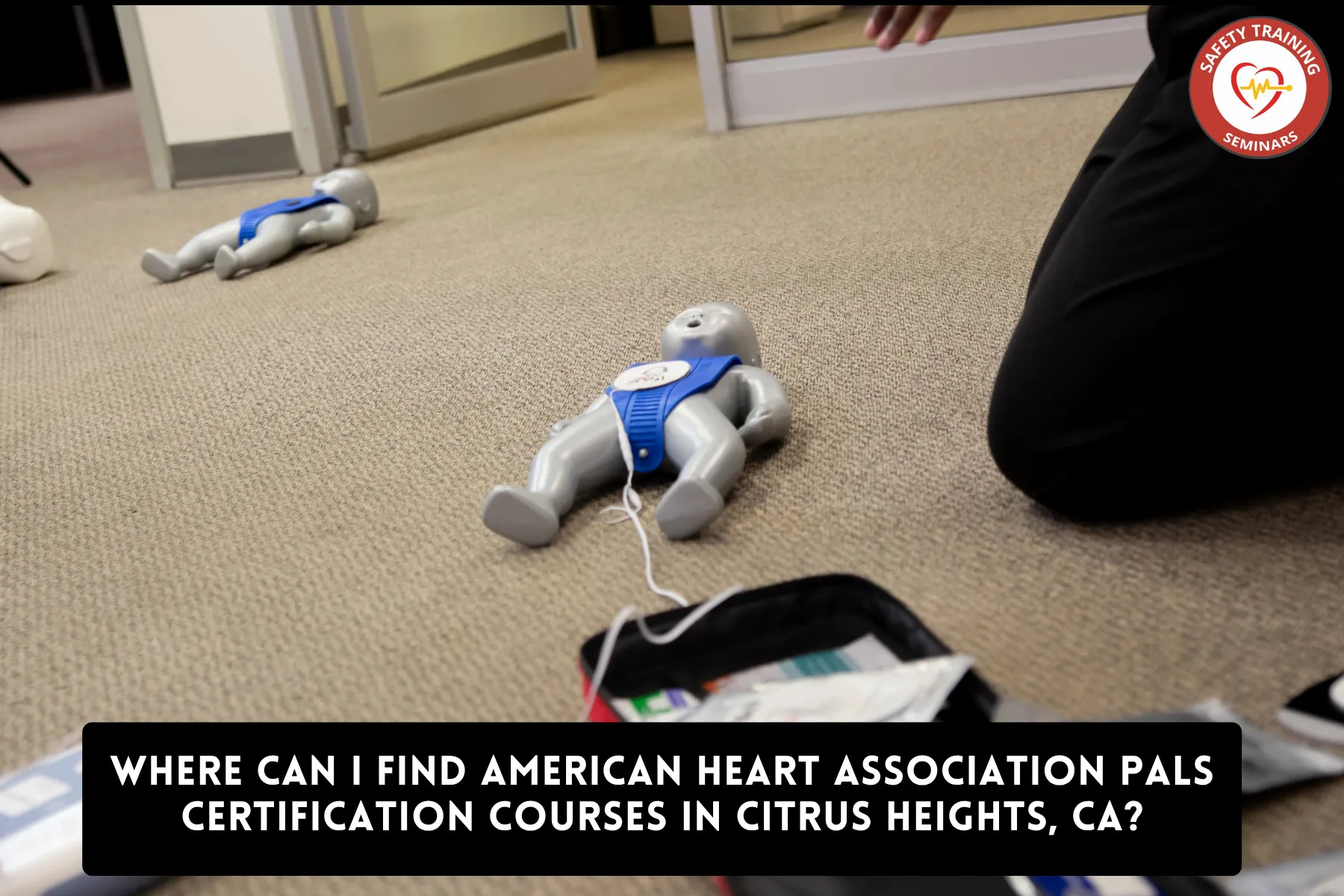
After the online part, you book a skills session at the Citrus Heights CPR Verification Station. There you perform the required resuscitation skills on manikins that give real-time feedback on compression depth, rate, and ventilation quality, measured against AHA standards. The skills session is listed at about 30 minutes.
When you pass both parts, your AHA PALS Provider Course Completion eCard is issued the same day.
Is there an instructor-led classroom option?
The training center’s materials mention both instructor-led and self-guided pathways. If you learn better in a traditional classroom with group megacode practice, call ahead and ask whether an instructor-led PALS session is on the current schedule.
PALS Initial Course vs. Renewal: Which One Do You Need?
| Situation | What to choose |
| You have never held a PALS card | Initial PALS Provider course |
| Your PALS card is current but expiring soon | PALS renewal (update) pathway |
| Your card has already expired | Check with the training center; some providers treat this as an initial course |
| Your employer requires a specific format | Confirm accepted formats with your employer first |
Both pathways lead to the same AHA PALS Provider eCard. Renewal reviews updated algorithms and medications and is usually quicker for clinicians who use PALS skills regularly. The PALS certification course in Citrus Heights page explains the initial, renewal, and HeartCode options in more detail.
What to Check Before You Register
A little preparation makes PALS much easier, especially for first-time learners:
- Confirm your BLS skills. PALS assumes you can already deliver high-quality CPR on infants and children. If your BLS card is expiring, consider renewing it around the same time.
- Review pediatric rhythms and drug dosing. Recognizing rhythms and knowing weight-based dosing are where most new learners feel stretched.
- Check your employer’s requirements. Some facilities have rules about blended versus classroom formats or expect proof of a specific course version.
- Verify current pricing and promotions. At the time of writing, Safety Training Seminars listed its PALS course at $290 with a low-price guarantee, and the site was advertising a promotional discount. Prices and promotions change, so confirm before booking.
- Plan your skills appointment. Finish the online part first, then pick a skills time that won’t collide with a shift.
Frequently Asked Questions
How long is a PALS certification valid?
An AHA PALS Provider eCard is valid for two years. Most clinicians renew within the last few months before expiration to avoid a gap in credentialing.
Can I complete PALS entirely online?
No. An AHA PALS card requires a hands-on skills check. The online HeartCode part covers the knowledge content, but you still need to finish the skills session in person, such as at the Citrus Heights CPR Verification Station.
How quickly will I receive my PALS card?
At Safety Training Seminars in Citrus Heights, the AHA eCard is issued the same day you pass the skills session. That helps if your employer has an upcoming credentialing deadline.
Do I need BLS before taking PALS?
Strong BLS skills are expected. PALS includes child and infant CPR during skills testing, so you should be comfortable with compressions, ventilations, and AED use going in. Many employers also require a separate, current BLS card.
Is the Citrus Heights location convenient for providers from Roseville or Fair Oaks?
For many people, yes. The Sunrise Boulevard center sits close to the Sacramento–Placer county line and is a common choice for clinicians living in Roseville, Fair Oaks, Orangevale, and Carmichael. Travel time depends on your starting point and the time of day.
What’s the difference between PALS and NRP?
PALS covers infants and children beyond the immediate newborn period, across emergency and inpatient settings. NRP focuses on resuscitating newborns at delivery. Labor and delivery and NICU staff often need NRP. Emergency and pediatric unit staff usually need PALS.
Finding Your PALS Class in Citrus Heights
For clinicians in and around Citrus Heights, the AHA PALS certification course at Safety Training Seminars on Sunrise Boulevard combines a self-paced online module with a short local skills session and a same-day eCard. It fits well for anyone balancing hospital shifts in Sacramento or Placer County. Before you register, confirm your employer’s format requirements, brush up on pediatric rhythms and dosing, and check current pricing. When you’re ready, visit the PALS course page to choose your pathway and book a skills appointment that fits your schedule.