Citrus Heights doesn’t slow down. Sandwiched between Roseville to the north and Sacramento to the south, this Sacramento County community of nearly 90,000 residents moves at a pace that its healthcare workforce knows intimately. The clinicians, paramedics, and allied health professionals working across Citrus Heights — from the busy retail corridors along Sunrise Boulevard to the quieter residential streets of Sylvan Highlands and Auburn Groves — carry a responsibility that never pauses between shifts: staying current on life-saving emergency response skills. BLS, ACLS, and PALS aren’t bureaucratic checkboxes. They’re the foundation of clinical competency in a community where medical emergencies don’t wait for convenient timing.
Sacramento County’s healthcare infrastructure has grown steadily, and Citrus Heights functions as a key node in that system. Professionals working at Mercy San Juan Medical Center minutes away in Carmichael, or commuting to Sutter Roseville Medical Center or Kaiser Permanente Roseville Medical Center, make up a significant portion of the area’s clinical workforce — all of whom operate on AHA’s two-year renewal cycle. In neighborhoods like Rusch Park and Antelope Road, nurses, respiratory therapists, and emergency technicians are constantly navigating the challenge of fitting a full-day training program into a schedule built around rotating shifts, long commutes, and family obligations.
That challenge is precisely why understanding the difference between instructor-led classroom programs and Self-Guided Learning™ courses paired with CPR Verification Station™ learning centers matters so much right now. This guide breaks both options down honestly, so healthcare professionals in Citrus Heights can make an informed decision about how to successfully complete their BLS course, ACLS course, or PALS course and receive their AHA Course Completion eCard without unnecessary disruption to their working lives.
Overview of CPR Training Options in Citrus Heights
Two primary formats serve the CPR training needs of healthcare professionals throughout the Citrus Heights area:
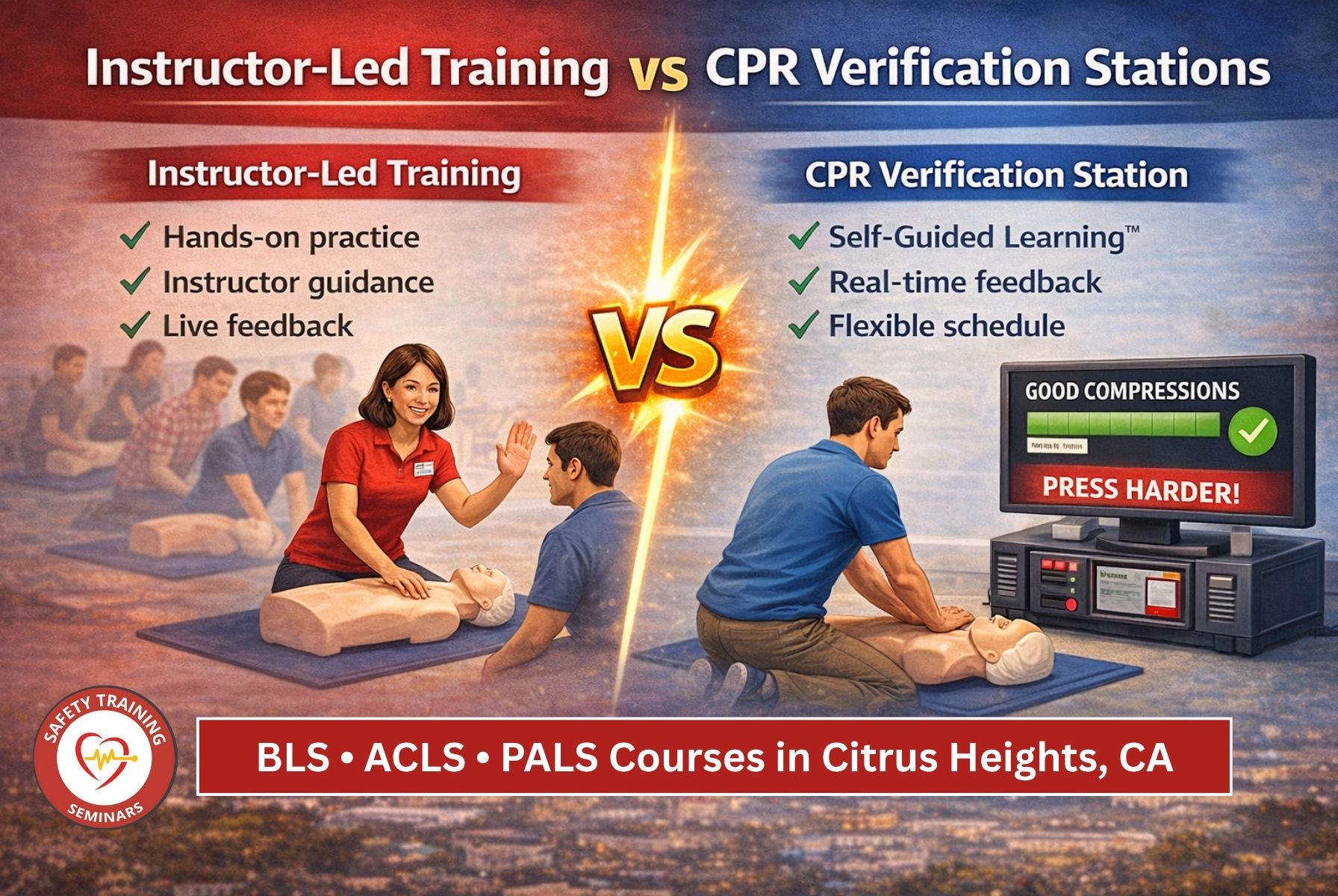
- Instructor-Led Training — A structured, in-person classroom program delivered on a fixed schedule by a course instructor, covering both the cognitive and hands-on skills components in a single session.
- Self-Guided Learning™ + CPR Verification Stations — A split-format model where participants complete adaptive online coursework at their own pace, then attend a focused skills evaluation at a CPR Verification Station™ learning center.
Both pathways lead to the same destination: an AHA Course Completion eCard confirming you’ve successfully completed the course. The route, however, is where the two diverge sharply — in terms of time, convenience, and how well each one accommodates the realities of modern clinical work.
Traditional Instructor-Led CPR Training in Citrus Heights
Instructor-led training has long served as the default format for BLS, ACLS, and PALS programs throughout Sacramento County. In this setup, a group of participants gathers at a designated training site on a scheduled day. A course instructor walks the group through AHA-approved curriculum content — typically through video modules followed by live demonstration — before rotating participants through hands-on skill stations where they practice compressions, airway management, defibrillation, and more complex scenario-based protocols depending on the course level.
For clinical teams at Mercy San Juan Medical Center or professionals traveling in from Folsom or Rancho Cordova, employer-organized group sessions in this format have traditionally made logistical sense. When a hospital coordinates the session and brings the trainer on-site, the fixed-schedule model works reasonably well. The challenge arises when healthcare workers need to find and attend sessions independently.
How Instructor-Led Training Works
A standard instructor-led BLS class in Citrus Heights typically runs between three and four hours. ACLS courses extend significantly longer — often six to eight hours — due to the complexity of rhythm recognition, pharmacology review, and team-based resuscitation scenarios. PALS programs cover similar ground through a pediatric lens, requiring participants to demonstrate competency in age-specific assessment and intervention techniques.
Throughout each session, the course instructor observes skill performance, coaches individual learners, and ultimately confirms when participants have met the AHA’s requirements. Once the session wraps, learners receive their AHA Course Completion eCard — provided everything was completed correctly the first time. The in-person, real-time nature of this model is both its strength and its limitation.
Limitations of Instructor-Led Classes
For a healthcare professional in Citrus Heights working rotating shifts, the fixed-schedule requirement of instructor-led training is where the cracks appear. Imagine finishing a 12-hour overnight shift at a Sacramento County facility and then being expected to arrive focused and alert at a training center by 8 a.m. The cognitive load of a full ACLS program in that condition isn’t just inconvenient — it can actually undermine learning retention.
Scheduling scarcity adds another layer. Popular ACLS and PALS courses near major Sacramento-area medical centers fill up quickly. A professional in the Sylvan Highlands neighborhood whose renewal deadline is six weeks out may discover that every available session within driving distance of Citrus Heights is already booked. Waitlisting becomes the only option — and in a compliance-driven field, waiting isn’t always possible. Add Highway 50 or I-80 congestion for those commuting to Sacramento or Roseville for training, and the time cost of instructor-led programs grows fast.
The Rise of CPR Verification Stations in Citrus Heights
Across Sacramento County, healthcare training providers and clinical employers alike have recognized that the traditional classroom model doesn’t scale well for a workforce as diverse and schedule-constrained as today’s medical community. CPR Verification Stations have emerged as the practical response to that gap — a technology-driven approach that separates the skills verification process from the rigid constraints of group-session scheduling.
Adoption has grown steadily among hospitals and training providers who’ve seen firsthand how the older model creates avoidable compliance delays. In a community like Citrus Heights, where clinical professionals commute to facilities spread across Carmichael, Roseville, Folsom, and Sacramento, a more flexible verification system isn’t a luxury — it’s a logical evolution.
What Is a CPR Verification Station?
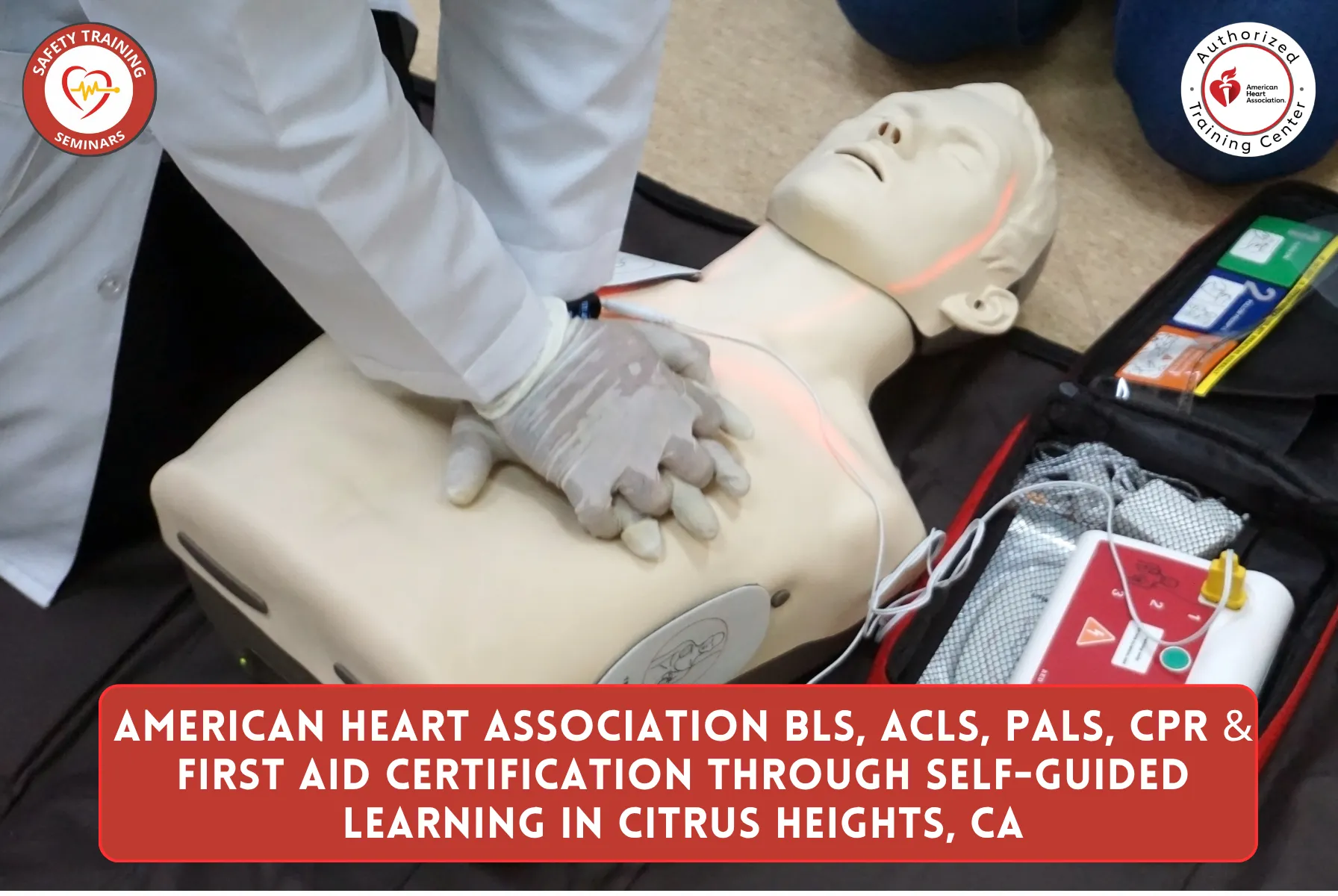
A CPR Verification Station™ learning center uses instrumented manikins embedded with sensor technology to capture real-time CPR performance data. Every compression is measured for depth, rate, and full chest recoil. Every ventilation is tracked for timing and volume. The system evaluates performance against AHA standards automatically, providing immediate, objective feedback that doesn’t vary based on who happens to be in the room observing.
This consistency is a meaningful advantage. In a traditional classroom, two learners demonstrating the same technique might receive different feedback depending on the instructor’s angle of observation, their workload during the session, or simply the number of participants competing for attention. A CPR Verification Station™ eliminates that variability entirely.
How Self-Guided BLS, ACLS, and PALS Courses Work
The online component of the Self-Guided Learning™ model is built around the HeartCode® Complete course — an AHA-approved digital curriculum that delivers comprehensive BLS, ACLS, or PALS content through an intelligent, learner-responsive platform. The technology behind it is True Adaptive™ learning powered by Area9 Lyceum, which continuously monitors how each participant is engaging with the material and adjusts the experience accordingly.
For an ICU nurse in Citrus Heights renewing her ACLS course, this means the platform recognizes her existing fluency with advanced cardiac rhythms and doesn’t spend 40 minutes reviewing content she clearly already knows. It advances to the areas where reinforcement is genuinely needed. For a newer clinician working through a PALS program for the first time, the same system slows down, revisits, and reinforces until competency is demonstrated. True Adaptive™ learning powered by Area9 Lyceum makes the experience both more efficient and more effective — simultaneously.
Once the HeartCode® Complete course is finished, the participant schedules a skills session at a nearby CPR Verification Station™ location. The hands-on component is focused, time-efficient, and produces an objective record of performance against AHA standards. After that, the AHA Course Completion eCard follows.
Key Advantages of CPR Verification Stations
For healthcare professionals throughout the Citrus Heights area and surrounding Sacramento County communities, the practical benefits of this model stack up quickly:
- On-demand scheduling — The HeartCode® Complete online portion can be accessed anytime — early morning before a shift, late at night after one ends, or split across several sessions on different days.
- Reduced total time investment — True Adaptive™ learning powered by Area9 Lyceum removes redundant review for experienced learners, meaningfully cutting down the hours required to complete the course.
- Objective, standardized skills assessment — Sensor-based CPR Verification Stations deliver consistent measurement regardless of session size, instructor, or time of day.
- Accessible locally — Skills sessions are brief and flexible to book, making them far less disruptive to a Citrus Heights professional’s weekly calendar than a full classroom day.
Why Healthcare Professionals in Citrus Heights Prefer Self-Guided Learning
The Antelope Road corridor and neighborhoods stretching through Auburn Groves are home to a significant number of clinical workers who commute daily to Sacramento County’s major healthcare facilities. For these professionals, the appeal of Self-Guided Learning™ courses isn’t about cutting corners — it’s about reclaiming control over their time without compromising the quality of their training.
A paramedic rotating between Citrus Heights Fire Department coverage zones and Sacramento Metro area calls can’t predict what a given week will look like two months from now. Committing to a fixed ACLS class on a specific Saturday in Folsom or Rancho Cordova is a gamble. Completing the HeartCode® Complete online course across five flexible evening sessions and then booking a one-hour skills verification appointment is not. That predictability, within an unpredictable schedule, is what drives the strong preference for this format among working healthcare professionals in Citrus Heights.
Instructor-Led vs. CPR Verification Stations: Side-by-Side Comparison
Placed side by side, these two formats reveal starkly different philosophies about how CPR training should work. Instructor-led programs operate on the premise that learning is best when it happens collectively, in real time, with a trainer guiding every step. That approach carries real value for certain learners in certain situations — particularly those who are new to clinical environments or who learn better through live interaction and immediate verbal feedback.
Self-Guided Learning™ with CPR Verification Stations operates on a different premise: that knowledge acquisition and skills verification don’t need to happen simultaneously, that adaptive technology can personalize learning better than a group setting can, and that objective measurement is a more reliable evaluation tool than subjective observation. On the dimensions that matter most to working healthcare professionals — flexibility, speed, consistency, and local accessibility — the Self-Guided Learning™ model holds a decisive advantage.
Which Option Is Better for You in Citrus Heights?
Instructor-led training makes sense if you’re completing an ACLS or PALS course for the first time and want the structure of a guided classroom environment, or if your employer coordinates on-site sessions that align easily with your schedule. Group learning can be genuinely valuable for those who benefit from seeing peers work through the same scenarios and receiving real-time verbal coaching.
Self-Guided Learning™ is the stronger option if your schedule rotates, you’re renewing familiar material, or you simply need a more efficient path to completing your BLS Certification class in Citrus Heights, wrapping up your ACLS program, or finishing your PALS course without sacrificing a full workday. For most experienced healthcare professionals in Sacramento County, this is the format that actually fits life as it’s lived.
Local Demand for CPR BLS, ACLS, and PALS Training in Citrus Heights
The clinical workforce in and around Citrus Heights draws from a broad network of healthcare facilities across Sacramento County. Mercy San Juan Medical Center in neighboring Carmichael remains a major employer. Professionals also commute to Sutter Roseville Medical Center, Kaiser Permanente Roseville Medical Center, UC Davis Medical Center in Sacramento, and Methodist Hospital of Sacramento — all of which maintain active renewal requirements for their BLS, ACLS, and PALS-trained staff.
With AHA guidelines mandating renewal every two years, there’s a continuous and substantial demand for CPR training near Citrus Heights at any given time. As the region’s healthcare workforce grows and diversifies, that demand for accessible, flexible training solutions will only intensify.
How Safety Training Seminars Supports Modern CPR Training
Safety Training Seminars serves healthcare professionals across Citrus Heights, Carmichael, Roseville, Folsom, and the greater Sacramento County region by offering both instructor-led options and the Self-Guided Learning™ model with CPR Verification Station™ learning centers — giving every learner a path that actually works for their schedule and experience level.
Available programs include BLS, ACLS, PALS, NRP, and First Aid, covering the complete range of AHA training needs for clinical and non-clinical professionals. The combination of high-quality curriculum, flexible scheduling, and accessible local skills verification locations has made Safety Training Seminars a reliable resource for healthcare teams throughout northern California who need AHA-aligned training without the logistical obstacles of conventional providers.
The Future of CPR Training in Citrus Heights
The direction of the industry is clear: technology-integrated, learner-centered training is becoming the standard, not the alternative. True Adaptive™ learning powered by Area9 Lyceum and CPR Verification Stations are at the forefront of that shift, and the healthcare organizations leading in clinical quality are already embracing these tools. As Citrus Heights grows and Sacramento County’s medical infrastructure continues expanding, the professionals best positioned for long-term success will be those who’ve adopted training models designed for the pace and complexity of modern clinical practice.
Start Your BLS, ACLS, or PALS Course in Citrus Heights Today
Whether you’re pursuing a BLS course in Citrus Heights for the first time, renewing your ACLS program ahead of a compliance deadline, or working through a PALS course between shifts, a flexible, effective training path is ready for you. Healthcare professionals throughout Sacramento County — from Sylvan Highlands to Auburn Groves, from Folsom to Rancho Cordova — are already completing their courses, meeting their AHA requirements, and receiving their AHA Course Completion eCard through the Self-Guided Learning™ model.
Don’t let a fully booked classroom or a schedule conflict push your renewal past the deadline. Choose the format that matches your life, complete your BLS, ACLS, or PALS training in Citrus Heights on your terms, and stay at the top of your clinical game.